
Note: This article was originally shared with our local Bois-Franc & Nouveau Saint-Laurent Healthy Living Community on Facebook. [Click here to join our local discussions!]
As the weather warms and spring arrives, it’s great to see more people walking outside in my local Bois-Franc and Nouveau Saint-Laurent community. We truly have the ideal environment for it: parks, trails, open streets, and even hills. All we need to do is step outside. That’s why we love our neighbourhood.
These walks, whether casual neighbourhood strolls or organized meet-ups, are fantastic for both physical and mental health. Less screen time, more sunlight, more movement, and more social connection all add up.
When I started as a trainer 25 years ago, there was a big push for heart rate monitors to track intensity. The manufacturers of these devices were, of course, leading the charge. Gyms began selling them and trainers were offered kickbacks, so naturally they promoted them heavily to members. I know, because I was one of those trainers.
Over time, though, I realized that many people were overcomplicating exercise by focusing too much on numbers instead of learning how to understand their own body. For many people, heart rate monitoring can become a reductionist approach to fitness and doesn’t tell the full story.
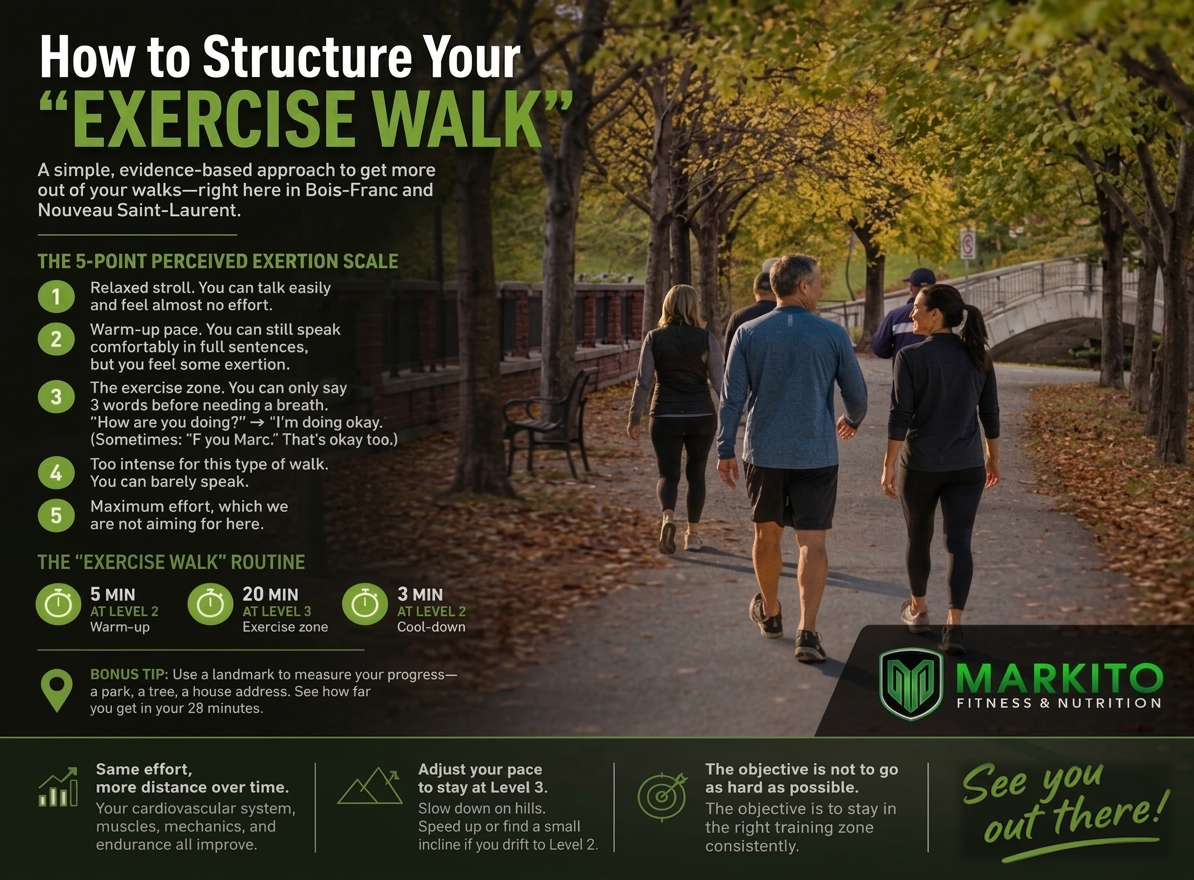
For most people, the five-point perceived exertion scale I teach, followed by my exercise walk routine, is more practical and effective than obsessing over heart rate zones or step counts.
Here’s the scale:
The “exercise walk” routine is simple:
That’s it, just 28 minutes, but when performed at the proper intensity as outlined above, this style of walking can produce greater physiological adaptation than walking casually for 2 hours while still able to comfortably carry on a full conversation.
Bonus tip: use a landmark to measure your progress. It could be a specific park, or a tree, or a house address. See how far you get with your 28 minutes.
What makes this powerful is that your perceived effort level stays the same with every outing, but over time you cover more distance in the same 28 minutes. That means your cardiovascular system, muscles, mechanics, and endurance are improving properly.
No gadgets needed. Just consistency, awareness, and the beautiful surroundings we already have in our community.
One important point: during your walk, you may need to adjust your speed to stay at Level 3. If you hit a hill and suddenly reach Level 4, slow down slightly. If you drift down to Level 2, increase your pace or find a small incline.
The objective is not to go as hard as possible, but to stay in the right training zone consistently.
(Note: If you are an older adult or have a pre-existing condition, such as a heart condition, please consult with a specialist or your physician before beginning a new exercise routine or increasing your physical activity intensity).
Marc Jaoudé
Naturopath, Health Educator
Nutrition & Exercise Specialist





Great information! I can’t wait to go for a walk with my dad.😎